Why Your SOC is Overworked and How CTI is the Cure
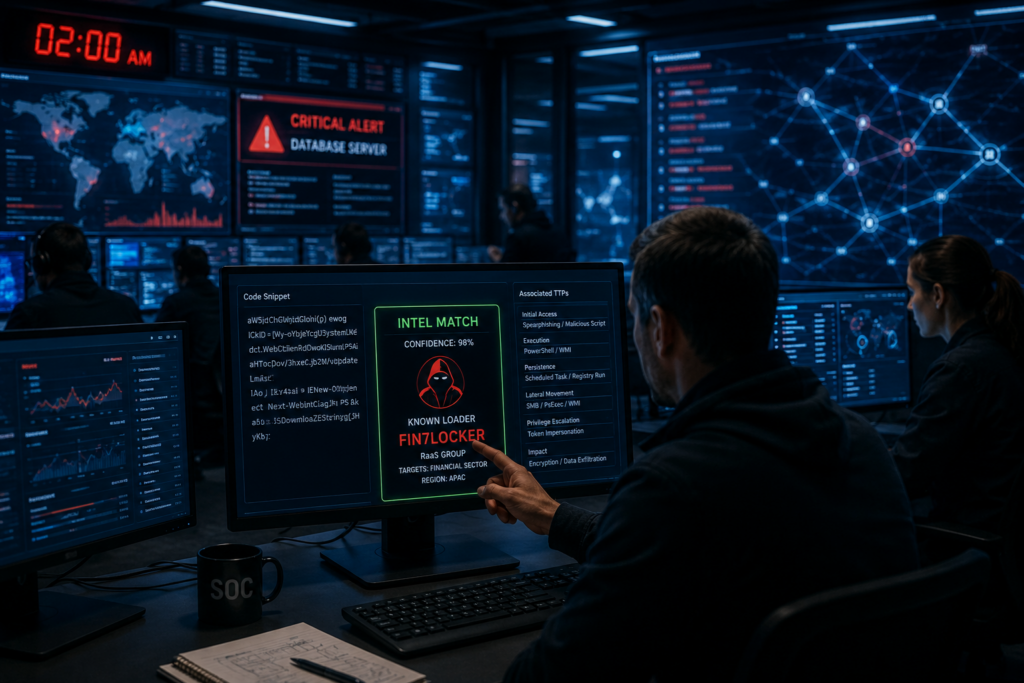
It was 2:00 AM, and the SOC was drowning. A suspicious obfuscated script had touched a critical database server. The initial plan? Pull the disk image, start a full forensic investigation, and spend the next 48 hours reversing code.
Instead, a senior analyst took a unique snippet of that code and ran it against our intelligence database. Within 90 seconds, we had a match. It wasn’t just a random script; it was a known loader used by a specific RaaS (Ransomware-as-a-Service) group targeting regional financial hubs. We didn’t need to “reverse” the attack—we already had the map. We shifted immediately from slow analysis to aggressive hunting for the group’s specific lateral movement techniques.
That is the power of a mature Threat Intelligence Program. It transforms your SOC from a reactive “clean-up crew” into an elite hunting force that stops attacks in minutes, not days.
The CTI Mission: What are we actually trying to achieve?
The CTI team isn’t just another line item, it’s a risk-reduction engine. The main objectives include:
- Reducing “Time to Ground Truth”: Providing the context needed to skip long forensic cycles and move straight to containment.
- Strategic Roadmapping: Informing long-term security investments based on which threat actors are actually targeting your industry.
- Proactive Defense: Moving the battleground outside your perimeter by identifying threats before they hit your firewalls.
The Modern Intelligence Landscape
CTI is no longer just “IP blocklists.” Today’s program covers a massive technical, physical, and brand surface:
- External Attack Surface Management (EASM): Seeing your digital footprint exactly how an attacker sees it, from forgotten cloud buckets to exposed RDP ports.
- Third-Party & Supply Chain Intelligence: Monitoring the threat landscape of your vendors. You are only as secure as your weakest API connection or software provider; if they are being targeted, you need to know.
- Geopolitical Intelligence: Translating real-world events (regional conflicts, sanctions, elections) into cyber risk, anticipating how nation-state actors will shift their targeting toward your sector or geographic operations.
- Predictive Intelligence: Moving beyond “what happened yesterday” by using AI and pattern recognition to identify adversary infrastructure (like newly registered domains or staging servers) before the attack is ever launched.
- Deceptive Intelligence: Using active defense (honeypots and decoy assets) to lure attackers in, gathering hyper-relevant, high-fidelity intelligence on exactly how they try to breach your specific environment.
- Vulnerability Intelligence: Prioritizing patches based on what is being actively exploited in the wild by threat actors, rather than just chasing high CVSS scores.
- Dark Web Monitoring & Brand Protection: Identifying leaked credentials, “access-for-sale” postings involving your domain, and taking down look-alike phishing sites before your customers do.
To operationalize this massive landscape, you need to structure your program around the golden triad: People, Process, and Technology.
1. People: Building the Engine Room
Building a CTI team requires more than just hiring analysts who know how to pivot on malware. It requires a deliberate team-building strategy.
- Clear Roles & Responsibilities: Ambiguity kills intelligence programs. You must clearly define who is handling tactical integrations (CTI Engineers), who is analyzing the threats (CTI Analysts), and who is communicating with the board (Intelligence Manager).
- The Team Lifecycle: Build your hiring and development plan around Tuckman’s stages of group development:
- Forming: Hiring the right mix of technical and analytical minds and setting the vision.
- Storming: Navigating the friction of integrating CTI with a SOC that might be resistant to new workflows.
- Norming: Establishing standard rhythms, trust, and reliable outputs.
- Performing: Reaching that “2:00 AM” level of seamless, high-speed execution.
- Adjourning: Managing transitions smoothly when team members move on to new roles.
- Performance Appraisals & KPIs: Don’t measure your team by “number of IOCs ingested.” Measure them by actionable metrics, like the number of proactive firewall blocks initiated by intel, or the reduction in SOC triage time.
- Recognition is Key: CTI is a high-burnout field. Publicly recognizing a team member when their intelligence brief successfully thwarts an attack or aids in a rapid incident response is critical for retention.
2. Process: Your Institutional Memory
The reality of cybersecurity is high turnover. If your analysts’ knowledge leaves when they do, your program dies. Your Standard Operating Procedures (SOPs) and FAQs are critical company assets that must be continuously updated.
- Onboarding New Clients/Business Units: You need a strict SOP for creating a baseline Cyber Threat Profile whenever a new entity is brought under your protection. What are their crown jewels? Who are their specific adversaries?
- Standardized Reporting Cadence: The process for building tactical weekly roundups, operational monthly summaries, and strategic quarterly board reports must be templated and predictable.
- The Intelligence Cycle SOPs: Document exactly how a raw indicator is verified, how false positives are stripped out, and how an alert is escalated. When a new analyst joins, they should be able to read the SOP and start hunting on day one.
3. Technology: The Connective Tissue
Intelligence is useless if it stays in an isolated database or a PDF report. To scale, your Threat Intelligence Platform (TIP) must be deeply embedded into your existing security stack.
- SIEM & SOAR Integration: Your SOAR should automatically query your TIP for every incoming SIEM alert, instantly enriching the ticket with actor attribution and context before a human analyst even looks at it.
- EDR Integration: High-confidence indicators (like file hashes from a new ransomware campaign) should automatically push to your Endpoint Detection and Response tools for real-time blocking.
- Firewall & Perimeter Controls: Integrating your TIP with your edge devices ensures that malicious infrastructure is dynamically blocked across the enterprise without manual intervention.
Investing in a Threat Intelligence Program isn’t about buying more feeds; it’s about aligning your People, Processes, and Technology to buy time. It’s the difference between a SOC that is constantly surprised and an organization that is consistently prepared.